
Strategic Role in Science Centres

Updated: Apr 23
In an era where science and technology are rapidly evolving, science centres play a crucial role in educating the public and inspiring future generations. However, the effectiveness of these institutions often hinges on the strategic leadership guiding them.
Understanding Strategic Leadership
Strategic leadership involves making decisions that shape the direction of an organization while considering both short-term and long-term goals. In the context of science centres, strategic leaders must navigate a complex landscape that includes educational objectives, community engagement, funding challenges, and technological advancements.
Key Characteristics of Strategic Leaders
Visionary Thinking
Strategic leaders possess a clear vision for the future of their organization. They can anticipate trends and challenges in the scientific community and adapt their strategies accordingly.
Collaborative Approach
Effective leaders foster collaboration among staff, stakeholders, and the community. They understand that diverse perspectives can lead to innovative solutions.
Adaptability
The ability to pivot in response to changing circumstances is vital. Strategic leaders must be flexible and open to new ideas, especially in a field as dynamic as science.
Strong Communication Skills
Clear communication is essential for conveying the organization's mission and engaging with various audiences, from educators to policymakers.
Commitment to Education
A passion for science education drives strategic leaders to create programs that inspire curiosity and foster learning.
The Role of Science Centres in Society
Science centres serve as hubs for learning and exploration, providing hands-on experiences that make science accessible to all. They play a vital role in:
Promoting STEM Education
Science centres encourage interest in science, technology, engineering, and mathematics (STEM) fields, particularly among young people.
Fostering Community Engagement
By hosting events, workshops, and exhibitions, science centres engage the community and promote a culture of inquiry.
Supporting Research and Innovation
Many science centres collaborate with universities and research institutions, contributing to scientific advancements and innovation.
Case Study: Nehru Science Centre
This study examines the transformative role of the Nehru Science Centre, Mumbai (NSCM), as a driver of tourism, education, and cultural enrichment. By analyzing visitor statistics and programmatic innovations from 2017 to 2023, the study positions NSCM as a model for museum-driven development within the global context.
Background of Nehru Science Centre
Since its inception, the NSCM has developed a comprehensive infrastructure to support its mission of science popularization and education. The center, conceived in the late 1960s and taking shape as India's one of the largest interactive science centers by 1977 with the opening of the 'Light & Sight' exhibition, followed by the Science Park in 1979, was fully opened to the public in 1985. The center boasts a sprawling 6 acres (24,000 sq. m.) of science park, housing over 500 hands-on and interactive exhibits on various aspects of science and technology (Annual Activity Reports & Visitor Statistics, 2017-2024).
Methodology
This paper employs a case study approach, focusing on the Nehru Science Centre, Mumbai, to analyze the role of science museums in cultural and tourism development. The study utilizes a mixed-methods approach, incorporating both quantitative and qualitative data. Primarily, the visitor statistics from 2017 to 2024 will be analyzed to identify trends and patterns in visitor numbers, including the impact of collaborations with travel agencies during the Year 1995-1996.
Quantitative Analysis: Visitor Statistics
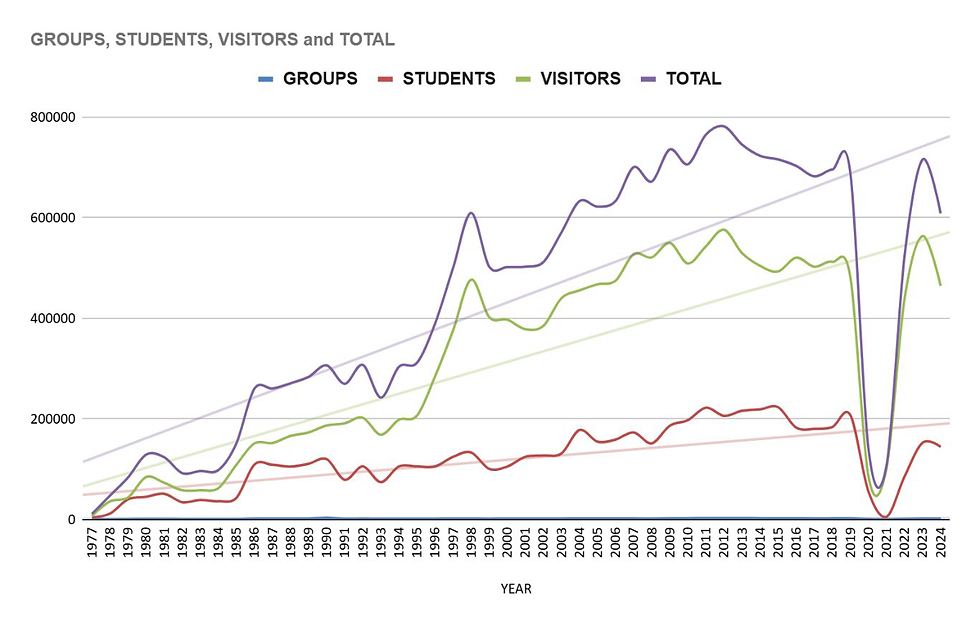
The primary quantitative data source for this study is the visitor statistics of NSCM, spanning the period from 1977 to 2024 (Nehru Science Centre Administration, 2017-2023). This data includes:
● Total Visitor Numbers: Annual visitor counts, providing an overview of overall footfall trends.
● Visitor Demographics: Data on visitor categories, such as school groups, families, and individual tourists, allowing for an analysis of visitor diversity.
● Impact of Specific Programs: Assessing the impact of specific events and exhibitions on visitor attendance through comparative analysis.
These statistics were analyzed using descriptive statistics and time-series analysis to identify trends, patterns, and correlations. Predictive modeling was also employed to assess the potential impact of specific initiatives on future visitor numbers (Choong. et all, 2008).
Qualitative Analysis: Programmatic Reviews
In addition to quantitative data, this study incorporates qualitative insights derived from:
● Review of NSCM's Educational Programs: Evaluation of the content, delivery, and impact of educational programs, including school workshops, science demonstrations, and interactive exhibits.
● Assessment of Community Engagement Initiatives: Evaluation of NSCM's outreach programs, community events, and public engagement activities (ASTC, 2022).
● Contextual Analysis of COVID-19 Adaptation: Review of NSCM's strategies for adapting to the challenges posed by the COVID-19 pandemic, including the implementation of virtual programs and online resources.
This qualitative analysis was conducted through document reviews, program evaluations, and contextual analysis of NSCM's strategic initiatives.
Data Collection and Analysis Tools
● Data related to visitor number was provided by the Nehru Science Centre Administration, Official Website (Nehru Science Centre Administration,1977-2024).
● MS Excel and Google Sheets were used for data analysis and graphical representation.
● OLS Regression Analysis using Python Coding and Plotting of Data.
Hypothesis Model: Linear Trend Validity
● Null Hypothesis (H0): A linear model adequately represents the trend of visitor numbers across the entire time period.
● Alternative Hypothesis (H1): A non-linear model provides a better fit for the trend of visitor numbers across the entire time period.
● Analysis: Compare the goodness-of-fit of linear regression models with non-linear models (e.g., polynomial regression) using statistical measures like R-squared or AIC/BIC.
Results of Study
● Wide Reach: The center engages a significant number of visitors through various programs, both within its premises and through outreach initiatives like the Mobile Science Exhibition (MSE).
● Popularity of Immersive Experiences: Programs like the Science on a Sphere and 3D Science Shows consistently attract large audiences, indicating the effectiveness of immersive and interactive formats in science communication.
● Strong Interest in Astronomy: The introduction and subsequent popularity of the Taramandal/Planetarium/Odyssey shows, along with the consistent engagement in sky observation programs, demonstrate a strong public interest in astronomy.
● Adaptation During Pandemic: While the years 2020-21 saw a dip in activities due to the COVID-19 pandemic, the center adapted by offering online lectures and virtual engagement, as seen in the Popular Science Lectures.
● Focus on Outreach: The continued efforts through the MSE program to reach visitors in remote areas and aspirational districts underscore NSCM's commitment to inclusive science education.
● Innovation Hub Engagement: The Innovation Hub provides a platform for nurturing creativity and innovation among students, although participation numbers have varied.
● Educational Enrichment: Science Seminars at the Regional and National level offer valuable opportunities for students and educators to delve deeper into scientific topics and interact with experts.
● Hands-on Learning: Vacation Hobby Workshops and the Creative Ability Centre programs within and outside the Science Centre provide hands-on experiences that encourage creativity and practical application of scientific principles. The significant number of participants in CAC programs outside the center in recent years indicates a strong outreach effort.
● Diverse Creative Outlets: A wide array of creative programs and competitions, including painting, slogan writing, quizzes, essay writing, rangoli, elocution, dance, poster making, robotics, and workshops, cater to varied interests and nurture different skills. The shift towards online competitions and workshops during the pandemic broadened the reach of these activities.
● Community Engagement: The CAC actively engages the community through events like science fairs and various creative competitions, fostering a culture of science and creativity beyond the formal education system.
● Teachers' Training Programs (TTP): These programs show a consistent effort to enhance the skills and knowledge of teachers in science education. The significant increase in the number of teachers trained and teaching aids/kits developed in 2021-22 and 2023-24 indicates a strong focus on empowering educators.
● Computer Training Programs: While fewer in number, these programs provide essential digital literacy skills to participants.
● Astronomy & Telescope Making Program: This program fosters interest in astronomy and provides hands-on experience in telescope making, with a notable increase in participants and projects made in 2021-22 and 2023-24.
● Aeromodelling: The aeromodelling training introduces participants to the principles of flight and model aircraft construction, with consistent program offerings and a significant number of models made in 2023-24.
● Model Rocketry: This program engages participants in the exciting field of rocketry, providing both theoretical knowledge and practical model building experience, with a high number of models made in 2022-23.
Challenges Faced by Science Centre
The qualitative analysis of NSCM's programs and initiatives provides valuable insights into the center's impact on tourism, education, and cultural enrichment:
Collaboration with Travel Agencies and Tourism Impact:
o Strategic collaborations with travel agencies have been a key component of NSCM's strategy to enhance its visibility and position itself as a prominent destination for cultural and educational tourism. Significant increase in visitor figures after 1995, after collaborating with the Local Tourist Bus operators Mumbai Darshan, Mumbai Safari, Neeta Travels etc.
o Globally, examples of successful collaborations between museums and tourism entities highlight the potential benefits. For instance, UNESCO has partnered with the Boston Museum of Science to launch exhibitions on World Heritage sites, demonstrating how museums can leverage partnerships to raise awareness and attract visitors (UNESCO World Heritage Centre, 2010). Liberty Science Center in New Jersey actively promotes itself as a must-see destination and provides information on nearby lodging and transportation, effectively integrating itself into the local tourism infrastructure (Liberty Science Center, n.d.).
Impact of Ticketing Categories and Packages
○ NSCM offers a diverse range of ticketing categories and packages designed to cater to various visitor segments and enhance public engagement. These options include entry tickets for general visitors, discount rates for group visits and students (including those from government and municipal schools), and special packages for families. These packages often offer a more economical way for visitors to experience multiple offerings.
○ For instance, a package ticket combining the Science Centre and Science Odyssey is priced at ₹130 for general visitors, while separate tickets would cost ₹70 and ₹80 respectively. Special provisions also exist for BPL cardholders, offering entry at a nominal fee of ₹5. The availability of family packages, like the one including the Science Centre, Science Odyssey, 3D Show, SOS, and Motion Simulator with a complimentary Sparkling High Voltage Demo, priced at ₹600 for a family of 4 and ₹900 for a family of 6, further encourages family visits by providing a comprehensive and value-driven experience.
Integration of Museum-Based Learning into Educational Curricula:
o NSCM has successfully integrated its exhibits and programs into educational frameworks, fostering a culture of curiosity and scientific literacy among students. The center's adoption of hybrid learning models and experiential pedagogy has enriched formal education while inspiring youth engagement with science.
o Best practices for integrating museum learning into educational curricula emphasize the use of real objects, hands-on activities, and exhibitions to make learning more meaningful. Museums can also provide resources and professional development for teachers to align museum visits with curriculum standards (Rautela and Sanyal, 2014).
Fostering the Culture of Tourism and Public Engagement with Science:
o NSCM has played a pivotal role in embedding a culture of tourism in society by emphasizing the value of museums as spaces for public learning and engagement. Science museums can employ various strategies to foster tourism culture and enhance public engagement with science. These include embracing smartphone culture by encouraging social media sharing like Facebook, Instagram Reels, X (Earlier known as Twitter), YouTube etc., hosting educational events, bringing exhibits to the community (Annual Activity Reports & Visitor Statistics, 2017-2024).
o The Association of Science and Technology Centers (ASTC) supports its members in building the civic capacities of their institutions and visitors, highlighting the role of science museums in addressing complex socio-scientific issues (American Medical Association, 2004). NSCM, as a prominent science center in India, likely employs a combination of these strategies to attract visitors and engage the public with the wonders of science.
Adaptation During the COVID-19 Pandemic
o During the COVID-19 pandemic, NSC adapted swiftly with virtual programs, demonstrating resilience and reinforcing the societal importance of museums. Science museums worldwide responded to the pandemic by rapidly increasing their digital engagement efforts.
o They offered free online learning resources, access to digital collections, virtual tours, and online exhibits. Many museums moved their in-person experiences online, creating virtual field trips, online quizzes, podcasts, and 3D/Virtual tours of their spaces. The Museum of Science in Boston used artificial intelligence to create a virtual exhibit allowing people to ask questions about the coronavirus (The Inclusive Museum Research Network, 2025). NSCM also implemented online lectures and virtual engagement during this period. For instance, NSCM organized the online Sky Observation Programs, Hands-On Experiments at Home, Electronics Circuitry like Arduino etc.
Economic Impact on Mumbai's Tourism Ecosystem
o Through quantitative analysis, this study highlights NSCM's contribution to Mumbai's tourism ecosystem and its broader implications for cultural development. While the provided snippets do offer specific data on the direct economic impact of NSCM on Mumbai's tourism industry between 1995 and 2019, the general economic trends in museum tourism in India suggest a positive contribution.
o In 2016, tourism in Mumbai generated INR 312 billion or 3.2% of the city's GDP and supported 637,900 jobs, 7.3% of its total employment. The sector was predicted to grow at an average annual rate of 8.8% to INR 720 billion by 2026 (3.1% of GDP). Science centers, in general, render valuable service to their communities and have a profound impact on local economies by attracting visitors. They are considered major tourist attractions and prime elements in cultural tourism (Maharashtra Tourism Development Corporation, Official Website and India Tourism Data Compendium Key Highlights, 2024). NSCM, with its large annual visitor numbers exceeding 700,000, including a significant number of students, contributes to the local economy through visitor spending and by enhancing Mumbai's appeal as an educational and cultural destination.
Conclusion
Nehru Science Centre, Mumbai, stands as a significant institution playing a dual role as an engine for cultural enrichment and tourism development. Through its interactive exhibits, educational programs, strategic collaborations, diverse ticketing options, well-developed infrastructure, extensive outreach through the Mobile Science Exhibition, engaging Science Shows and Lectures, the activities of the Creative Ability Centre, comprehensive Educational Training Programs, impactful Community Programmes, and regular Commemorative Events, NSCM has made substantial contributions to fostering scientific temper and attracting visitors. The center's resilience during the COVID-19 pandemic, marked by its swift adoption of virtual programs, further underscores its societal importance. As the tourism sector in India continues to grow, science museums like NSCM are well-positioned to leverage their unique offerings to contribute to local economies and promote a culture of scientific literacy.
Limitations
Linearity Assumption: The analysis heavily relies on linear regression, assuming a linear relationship between time (years) and visitor numbers. This may not accurately capture non-linear trends or cyclical patterns in visitor behavior.
External Factors: The analysis does not account for various external factors that could influence visitor numbers, such as:
Economic conditions
Changes in educational policies
Competition from other attractions
Marketing and promotional activities
The quality and changes in the exhibitions
Lack of Demographic Data: The research does not include demographic data about the visitors, for example, age, location, and the purpose of the visit. This data would greatly increase the research depth.
Future Scope:
Non-Linear Modeling: Explore non-linear regression models (e.g., polynomial, exponential) or time series analysis (e.g., ARIMA) to capture more complex trends.
External Factor Analysis: Incorporate external variables into the analysis (e.g., GDP, education spending, marketing budget) to understand their impact on visitor numbers.
Granular Time Series Analysis: Analyze monthly or weekly visitor data to identify seasonal patterns and short-term fluctuations.
Demographic Analysis: Collect and analyze demographic data to understand visitor profiles and preferences. This can inform targeted marketing and program development.
Comparative Analysis: Compare visitor trends at Nehru Science Centre with those at similar science centers in India or internationally.
Visitor Feedback Analysis: Collect and analyze visitor feedback (e.g., surveys, online reviews) to understand visitor satisfaction and identify areas for improvement.
For full research paper, please visit :
Comments